A Map to the Next World
Part I: A Warning on the Map: What I'm Telling You is Real

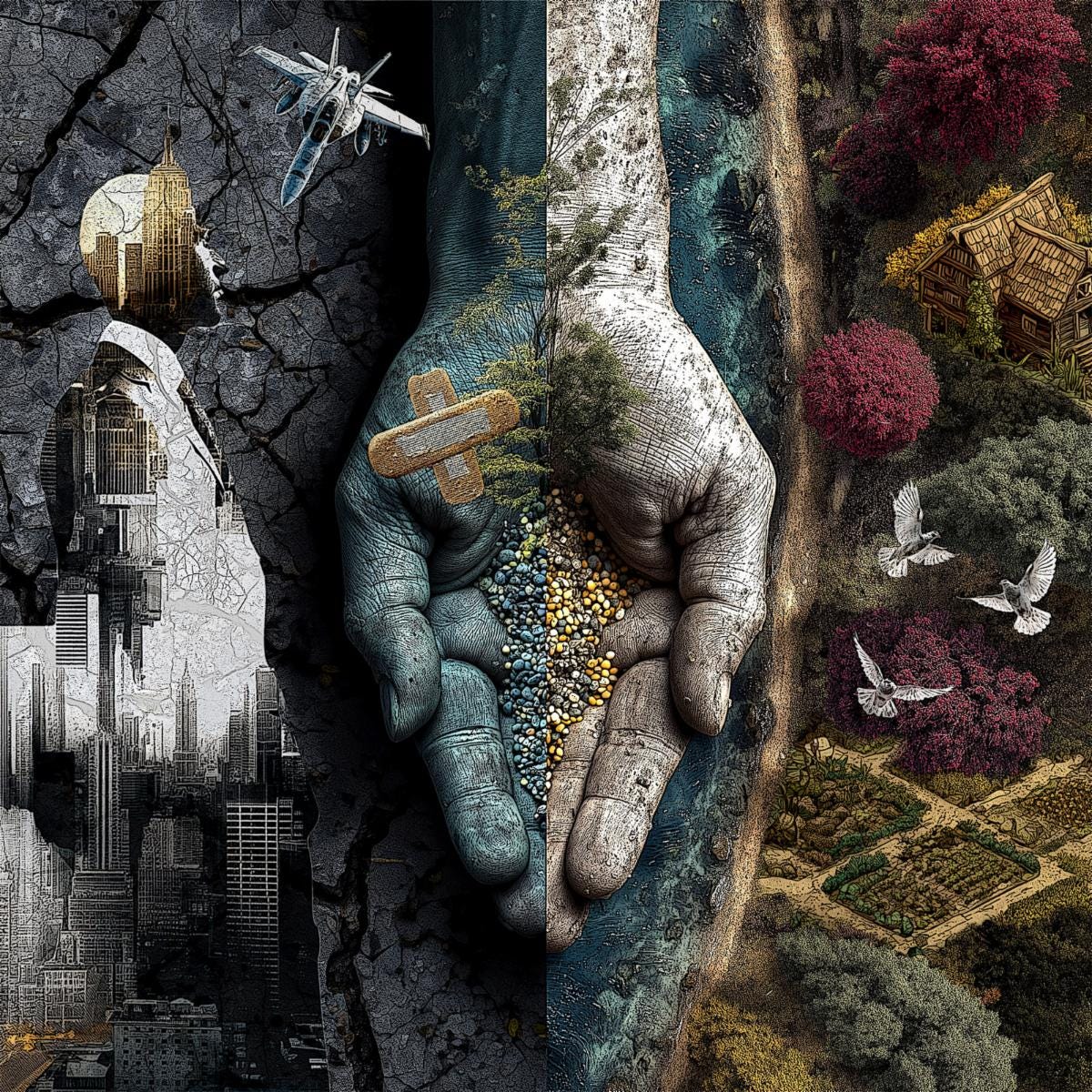
Seeded for Return [Collage]. Doug Van Houten
This is Part One of a 20-plus-part essay on making and following a map that might get us to the Next World, and on what it means to leave one world and eventually reach another, and on what it’s like for a community or a society to be between worlds, perhaps walking that long road for several generations. Think of this as a draft of an essay I’ll be working on for a while — or eventually a short book. Let me know what resonates with you.
My Substack postings will appear more or less at the same time on our Animas Valley Institute weekly “Soulcraft Musings,” which you can access here. I encourage you to join this free Animas list because our Musings include the voices of other Animas guides as well as soul-and-nature-oriented verse from familiar poets and others who may be new to you. Also, joining our list will provide you free access to several previous years of Soulcraft Musings, to upcoming Animas program information, and links to The Animas Commons, our online community with frequent events you can drop in on.
…We no longer know the names of the birds here,
how to speak to them by their personal names.
Once we knew everything in this lush promise.
What I am telling you is real and is printed in a warning on the map.…
~ Joy Harjo
We need a map to the Next World because our current world is clearly in its death throes.
Our current world has been variously named Dominator Culture, Empire, Imperialism, Colonialism, Trauma Culture, the Industrial Growth Society, Western-style Democracy, Predatory Capitalism, the Anthropocene, and Modernity. Looking through a psychosocial lens at its contemporary forms, I have, in earlier books and essays, offered two additional tags: Consumer Conformist Culture and Patho-Adolescent Egocentric Society.
If you’re reading this, you know Dominator Culture intimately and from the inside but here’s a few reminders of its most oppressive features: Dominator Culture is a world in which families and society as a whole are organized in top-down power structures where obedience to authority is expected; a world in which men commonly hold power over women, and traditional, constricting gender roles are imposed; qualities perceived as “feminine,” such as empathy and caregiving, are often devalued; a world with a high tolerance for violence, ranging from child and spousal abuse to chronic warfare, violence being seen as a legitimate means to maintain power and control; a world in which systems of belief normalize and justify these hierarchical relationships (social Darwinism, meritocracies, the Platonic/ Christian concept of the Great Chain of Being, the Hindu caste system, “the divine right of kings,” “might makes right,” “to the victor the spoils,” “it’s a dog-eat-dog world”); a world in which competition is seen as more fundamental and valuable than cooperation; a world that prioritizes winning, efficiency, individual achievement, “the right answer,” transactional relationships, and wealth accumulation and that undervalues collaboration, relational depth, kinship, community, wonder, mystery, and environment; a world that treats the Earth as a cache of extractable resources and as a refuse dump; a world in which the “other” is treated as an exploitable and expendable resource (other races, LGBTQ, women, the other-than-human world); a world of either/or thinking, a world viewed in dualistic terms (superior/inferior, in-group/out-group), thereby discouraging an appreciation of complexity and nuance; a world in which strategic, noncritical, and shallow thinking is prized over full-bodied feeling, full-presence sensing, deep imagination, and heart-centered thinking; a world that believes, or acts as if, unlimited economic growth is desirable or even possible; a world that is destroying life on Earth; a world in which very few humans ever fully grow up.
Some of these Dominator elements you may have personally managed to dodge or minimize or create alternatives to, but they are nonetheless structural societal realities that impact each one of us and most every life form and locale on Earth.
Nearly all present-day humans live in Dominator World, including those of us doing our best to resist it or interrupt it.
That last sentence is deeply distressing to write. It asserts a profoundly alarming and sobering reality, perhaps the single most essential reality for us to come to grips with, a reality even more ominous than climate disruption or surging authoritarianism because it is the root cause of both — indeed, the root cause of every facet of our current polycrisis.
We’ve arrived here in Dominator World by way of the pervasive undermining or outright destruction of Partnership Cultures[1] throughout the world over the past several thousand years.
Dominator Culture first appeared perhaps 10,000 years ago — in more than one place and in various forms — and, from its various centers, spread gradually until, in the twenty-first century, it has consumed nearly all existing societies.[2]
No one knows how long it will take for Dominator World to definitively end, but we’re now witnessing ample signs of collapse as seen in, for example, ever-present wars, climate disruption, and the worldwide surge of autocrats who, at best, are caricatures of leadership and, as a deeply inspiring contrast, in the growing number of visionary artisans and communities choosing or generating ecocentric and Partnership lifeways. Dominator Culture may still be the mainstream default, but we need not delay before we begin or continue our journey to the Next World. It’s possible to live amidst Dominator Culture but not be fully of it.
A second thing we don’t know is how long it will take to reach the Next World — or even if we ever will. Human extinction in this century is a possibility many of us despair over every day, even if we believe it’s unlikely. Short of extinction, it’s possible that human-wrought conditions on our planet in the coming decades will be so dire that our survival may be the best we can hope for — and for quite a while. But others have carefully considered the facts and concluded that’s it’s not too late to turn our ship around and that there are identifiable and feasible ways to do it.[3] But even if we succeed, we’ll still be in a transitional phase for quite some time as we build the ecocentric systems and social structures of life-sustaining societies, this phase being the first of two on our journey to the Next World. (I’ll have more to say about these two distinct phases later in this essay.)
Assuming we do manage to push forward on the journey to the Next World, it will nevertheless be a long one, possibly spanning centuries. How long depends on the availability of a helpful map, there being enough of us capable of following one, the level of resistance or repression from tyrants and their minions, how many of us band together on the journey, how deeply we’re able to support each other along the way, and environmental and climatic conditions en route. Although it will likely be a long, multi-generational journey, the voyage can be as rewarding and joyful as the destination. There may never have been a time in the human story in which we had a greater opportunity to be in deep service to both the past and future: to our ancestors (including other species, primeval single-celled organisms, and supernovas) who made our lives possible and who, we might imagine, dreamed us into being, as well as to future Earthly life whose prospects depend on what we do in our own lifetimes.
We need a map to the Next World, a way to navigate the long trail from where we are now to human cultures that, as Manda Scott puts it, we’ll be proud to leave behind for future generations — cultures that will provide life-enhancing support for all species and habitats. Other than being the next phase of our human contribution to life and evolution, there’s not a whole lot more we can say about what the Next World will be like, although later in this essay I’ll attempt to identify some general principles. We can’t know the specifics until we get there, in part because the Next World will be what we are able to create when we arrive, and what we are able to create then will have been made possible by who we become on the long journey between here and there, between now and then. A map of the Next world is not really possible but a map to get there is both possible and necessary.
Given the rapid collapse of Dominator World, now is the time to get serious (as well as playful) with generating a map to the Next World. What we need is not a set of strategies for fixing Dominator World so that it continues to work for that segment of humanity that currently benefits from it (in some limited and limiting ways), nor for trying to tweak the industrial growth society and consumer lifestyle so that they work for greater numbers of humans and species (as if that were possible), nor for attempting to replace predatory capitalism with some other kind of economy or worldview that we can consciously conjure with our strategic minds. What we need, rather, is a map of a journey to a World that is not appreciably conceivable from within Dominator World.
Nature, as always, provides the template for creating such a map.
Although it would be wise to construct our map using the same nature templates employed by previous peoples who managed to migrate from one world to the next, our construction materials must be our own contemporary languages, metaphors, and symbols — idioms we can understand and act on, even though the journey is necessarily through enigmatic realms. We won’t find our way using the maps of other peoples or from other times. We must make our own map.
This post is my introduction to a long 20-plus-part essay on a journey to the Next World and on a map that might help get us there. We’ll continue with Part Two next week. Thanks for tuning in. If you found this article helpful, please restack it to share it with your followers!
[1] Dominator and Partnership are terms borrowed from Riane Eisler’s The Chalice and the Blade: Our History, Our Future.
[2] Andrew Bard Schmookler, The Parable of the Tribes: the Problem of Power in Social Evolution, Second Edition (Albany, NY: State University of New York Press, 1995); Riane Eisler, The Chalice and the Blade: Our History, Our Future (San Francisco, Harper & Rowe, 1987); Paul Shepard, Nature and Madness (San Francisco: Sierra Club Books, 1982) and Coming Home to the Pleistocene (Covelo, CA: Island Press, 1998); David Graeber and David Wengrow, The Dawn of Everything: A New History of Humanity (New York: Farrar, Straus, and Giroux, 2021); John Zerzan (Ed.), Against Civilization: Readings and Reflections (Los Angeles: Feral House, 2005); Vanessa Machado de Oliviera, Hospicing Modernity: Facing Humanity’s Wrongs and the Implications for Social Activism (Berkeley, CA: North Atlantic Books, 2021); Wade Davis, The Wayfinders: Why Ancient Wisdom Matters in the Modern World (House of Anansi Press, 2009).
[3] Consider the work of Thomas Berry, Joanna Macy and Molly Brown, Jeremy Lent, Daniel Christian Wahl, Nate Hagens, Manda Scott, Nina Simons and Kenny Ausubel (Bioneers), Rob Hopkins, Duane Elgin, Vicki Robin, David Korten, Joe Brewer, Kate Raworth, Rebecca Solnit, and Kim Stanley Robinson, to mention a few.
Clearly humans as a predatory species are out of balance. When viewed through the lens of collective trauma, we humans need to be grounded, once again, in our mystical origins emanating from our ancestral stories mapped in our physiology and our entire being.
The Dominator culture emerged from partnership cultures. This transition needs to be understood, not just as one of random opportunity but organic and maybe inevitable growth. Also, re black/white good/bad thinking that lacks nuance and complexity, same caution applies to opposition of dominator vs partnership eras.