A Map to the Next World
Part IV: Soul and Mythopoetic Identity

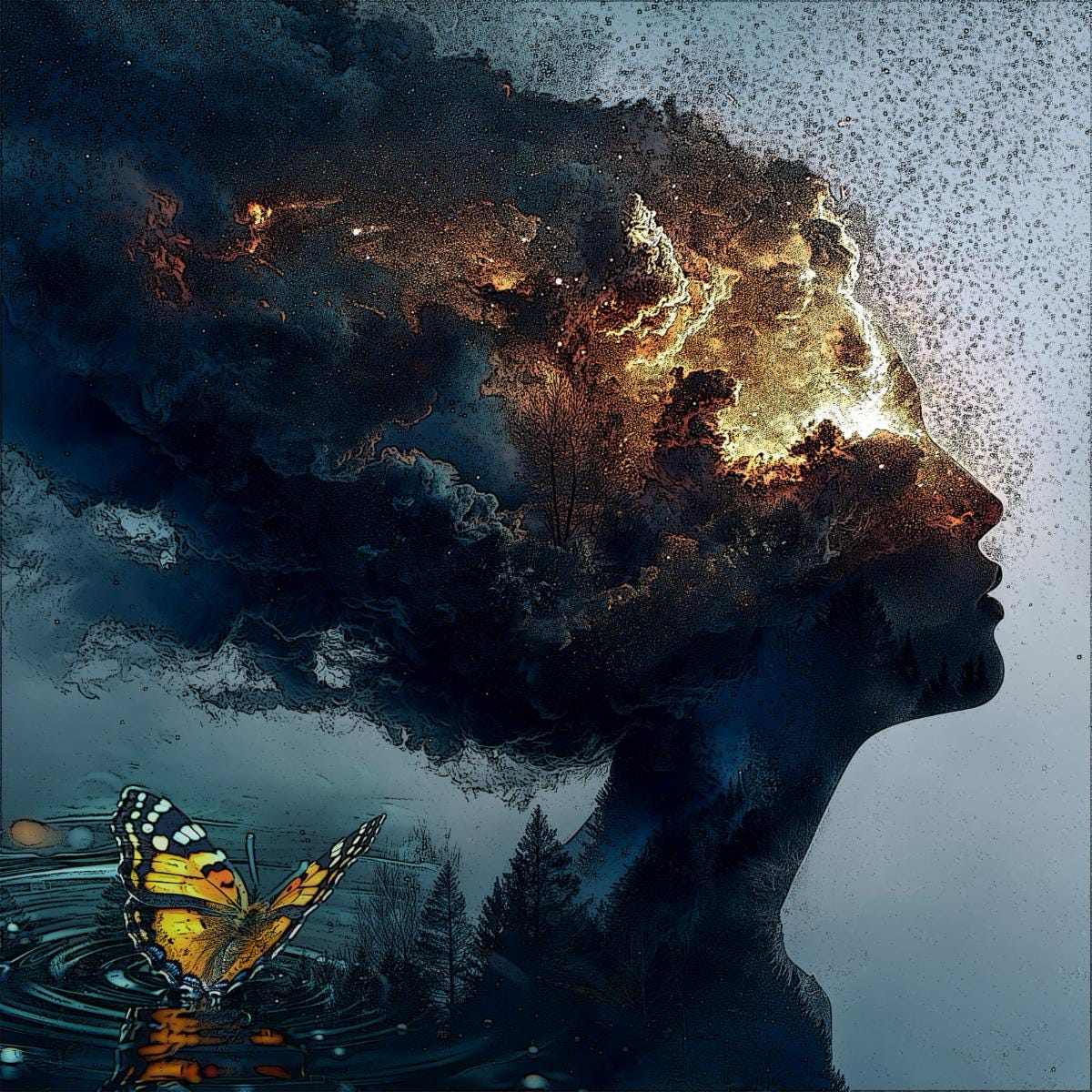
Storms Within, and Storms Without — Still We Imagine [Collage]. Doug Van Houten
This is Part Four of a 20-plus-part essay on making and following a map that might get us to the Next World, and on what it means to leave one world and eventually reach another, and on what it’s like for a community or a society to be between worlds, perhaps walking that long road for several generations. Think of this as a draft of an essay I’ll be working on for a while — or eventually a short book. Let me know what resonates with you. To fully understand or contextualize today’s part, you might want to read, reread, or at least scan the first three parts. If so, click here.
My Substack postings will appear more or less at the same time on our Animas Valley Institute weekly “Soulcraft Musings,” which you can access here. I encourage you to join this free Animas list because our Musings include the voices of other Animas guides as well as soul-and-nature-oriented verse from familiar poets and others who may be new to you. Also, joining our list will provide you free access to several previous years of Soulcraft Musings, to upcoming Animas program information, and links to The Animas Commons, our online community with frequent events you can drop in on.
Last week, I introduced you to the ecological conception of Soul by which we navigate at Animas Valley Institute, namely Soul as an individual’s innate place or niche in the gift that is the animate world — in other words, Soul as a kind of relationship, not as some kind of psychological or spiritual object or as our consciousness (“trapped in the body in life and liberated at death”) or as an independent entity within us or outside of us or as some quality of character or personality or psyche that exists independent of the world. This week, I want to write about the experience of soul as eco-niche — an experience that, sadly, is rare in Dominator world. Continuing the excerpt I began last week from The Journey of Soul Initiation:
Because knowledge of our Soul, our place in the greater web of life, is something we’re born with, this knowledge is necessarily precultural and prelinguistic. As a consequence, our unique place in the world cannot be identified, described, understood, or experienced in conventional cultural terms; it can’t be equated with an everyday social or vocational role or identity — such as physician, pianist, priest, president, or parent, or even the more generic categories of healer, artist, or leader. So how on Earth do we identify or name our Soul’s place?
Here’s an additional way to appreciate the difficulty: We humans possess a special realm or veneer of consciousness — our ego’s conscious self-awareness — that rides on top of the more extensive consciousness we have in common with all other species. Our human Ego (by which I mean our capacity for conscious self-reflection) is both a great boon and a great barrier.[1] For example, because each individual Ego, unlike the Soul, is a child of culture and language, we at first — in our childhood and teen years — come to understand our place culturally and linguistically, in terms of social roles. This is unavoidable, necessary, and a good thing. But we’re also born with an entirely different kind of knowledge, a felt-sense about our ecological place or niche in the world. This knowledge exists only within the deeper realm of consciousness that all species share, knowledge that is not linguistic but imaginal, knowledge that an immature, egocentric human Ego cannot access.
So the questions become: What is the nature of this innate, imagery-based, and mysterious knowledge about our ecological place in the world? How do we access this knowledge when it exists at a deeper level than the ego-consciousness that dominates our experience and sense of self by the time we’re in our early teens? How do we linguistically identify our Soul to ourselves and others once we experience it consciously?
In a word: metaphor.
When it comes to identifying Soul, we can only point or allude to it using metaphor — in the manner of poetry or myth. We can linguistically understand our Souls only indirectly, only mythopoetically. Not coincidentally, this is precisely how we learn about our Souls in the first place: We discover (or remember) our innate place, our true home, when the world mirrors it to us by way of nature-based metaphors, human archetypes, or other mythic or poetic images or symbols. We don’t choose these metaphors or figure them out with our strategic minds. Rather, we’re shown them in a moment of numinous vision or mystical revelation. They are shown to us by. . .what? “Mystery” is as good a way as any to name our benefactor, our guide, our initiator.
This is to say that when we begin to fathom and appreciate our unique econiche, we do so in the form of our mythopoetic identity, a phrase that Geneen Marie Haugen and I coined many years ago to name the way that human consciousness experiences and embraces Soul — through symbol and metaphor, image and dream, archetype and myth. So although Soul for me is an ecological concept, the process of coming to know our Soul is not ecological but psychological — and spiritual as well.
It’s important to keep in mind that Soul is not the same as mythopoetic identity. Soul is our unique eco-niche, while mythopoetic identity is how Soul is communicated to and represented by our human consciousness.
The embodiment of our Soul — the manifestation of our unique eco-niche — is our mature, adult life purpose, our singular destiny.
Although numinous visions or mystical revelations themselves do not specify a particular social or vocational role, we eventually need to identify and choose such a role as a delivery system for Soul. We need that delivery system in order to incarnate our mythopoetic identity and offer our unique gift to the world. But the delivery system is not our mythopoetic identity. Our job or task is not who we are.
What I mean by Soul, then, is something mystical but not upperworld mystical and not any more mystical (or less) than salmon or monarch migrations. It corresponds to what poet David Whyte refers to as “the largest conversation you can have with the world,” a conversation you were born to have and that only you can have and that the world needs you to have for it to be whole. This conversation — and the niche, role, function, identity, meaning, and purpose associated with it — is not cultural or even merely human; rather, it is ecological and mythopoetic, which is to say clothed and communicated in the metaphors, symbols, images, dreams, and archetypes of the wild world and of your own wild mind. As Diane di Prima reminds us: “you have a poetics: you step into the world / like a suit of readymade clothes.”[2]
This is actually true of all creatures, not just humans: Every being has its own innate poetics, and there’s no better way than poetry to identify a unique ecological niche. Try describing the niche of an individual fox, for example. You can point to some of the primary relationships she has with other species in a particular habitat and perhaps the way her uncommon cunning allows her to carry out her distinctive calling, but her niche is something more than that and categorically different. Her unique niche is the sum of all the relationships she has with everything else on Earth, especially the things in her ecosystem, something we can’t even get close to fully describing. The best way to understand a fox’s niche is to live for several years as a native in her neighborhood while offering your daily reverent attention to her wanderings and ways. Then you’ll know something of her niche but still not be able to describe it precisely or systematically. Your best option, really, for portraying her niche would be to recite fox stories, preferably outside at night around a fire or in the dark beneath blazing stars. Or fox poetry. Or vixen myth. And that of course is precisely how nature-based people have always done it.
It’s no different when it comes to linguistically portraying an individual human’s Soul.
Through the journey of soul initiation, we come to understand that we each were born as something like a poem, as a unique dance, as a story in conversation with other stories, as an essential and utterly singular episode in the unfolding story of Earth, of Cosmos. As Gary Snyder writes:
The world is made of stories. Good stories are hard to come by, and a good story that you can honestly call your own is an incredible gift. These stories are part of a bigger story that connects us all.[3]
On the Soul level, we are each like a story or a poem that was part of the world even before we were born or conceived. And this poem, this mythopoetic identity, remains a feature of the world even after we die. This poem might be, for example, “about” the way a cocoon is woven. Or “about” the way stone can anchor feather and feather reveal the secrets of stone. Before we consciously encounter it, we might imagine this poem to be hanging on a certain branch of a tree in a forest or waiting in a hollow spot on the land beneath leaf litter or hovering between two standing waves in a river. And we might imagine it calling to us — it wants us to find it. The journey of soul initiation is, in essence, a long wander in the “forest” in search of that poem. When we find it, it claims us — our Ego — and we are changed by the encounter, like being struck by lightning. In that moment, our Ego begins to be shaped into a handmaiden for that poem, a way to embody and celebrate it. To seek the Soul is to wander ever deeper into the world searching for the poem you’re destined to be a vehicle for. That poem has always been calling you. The day you’re ready to embark on the journey of soul initiation is the day you first hear that call. When you do, any life project that would have interfered with that journey falls away as vanishingly insignificant.
A few brief examples of mythopoetic identity might be helpful. Although it’s impossible to communicate the numinosity of the human Soul in a few words, here are five linguistic sketches, five exceedingly brief word portraits, that embody the wild mysteries of soul encounter and how they have been communicated mythopoetically to five individuals:
• The overseer who guides others into the oceanic depths of the psyche
• She who dances the Earth and dreams song to feed the longing
• Spark heart on bear path
• She who generates perception-expanding images and identity-destabilizing questions
• The impossible dreamer who weaves cocoons of transformation
Despite their brevity, you can tell that these soul-infused identities and purposes contrast with middleworld cultural roles. These are not job descriptions you’ll ever see advertised. They are not careers a vocational guidance counselor is going to recommend to you. They are of the dreamtime or the mythic. And they are the kinds of images and purposes utterly core to our deepest, innate human identities.
This post is Part Four of a 20-plus-part essay on a journey to the Next World and on a map that might help get us there. We’ll continue with Part Five next week. Thanks for tuning in. If you found this article helpful, please restack it to share it with your followers.
[1] In many spiritual circles, “the ego” is thought to be the primary problem, public enemy number one, something to rid oneself of. But without an Ego, we’re not human. The actual problem is not Egos but immature Egos (egocentric or self-centered Egos), by far the most common kind in the Western world today. The goal is not to get rid of the Ego but to mature it through wholing and Self-healing and deepen it by rooting it in Soul (by way of the journey of soul initiation).
[2] Diane di Prima, “Rant,” in Pieces of a Song (San Francisco: City Lights Books, 1990), 159.
[3] Gary Snyder, Back on the Fire (Berkeley, CA: Shoemaker and Hoard, 2007), 160.
Scottish poet, Kathy Galloway (who sadly passed last year), wrote a wonderful long poem called The Dream Of Learning Our True Name, in her poetry book of the same name.
It includes many lines like:
'woman with poems in her heart
taught us the art of receiving with grace'
'woman who remembers the future
taught us of silence, and fire in the snow'
'woman with fire in her heart
taught us to feel the heartbeat of life'
'and the Great Spirit who loves us
and has given us our true names
whispers them in the darkness
when we are alone
when we are weary
when we are despairing
and we are re-membered
in the heart of God.'
Your post reminded me of this.
Beautiful read Bill. A resonance of being. Metaphor. A soul journey. Loving this series! Thank you! 🙏❤️💫